
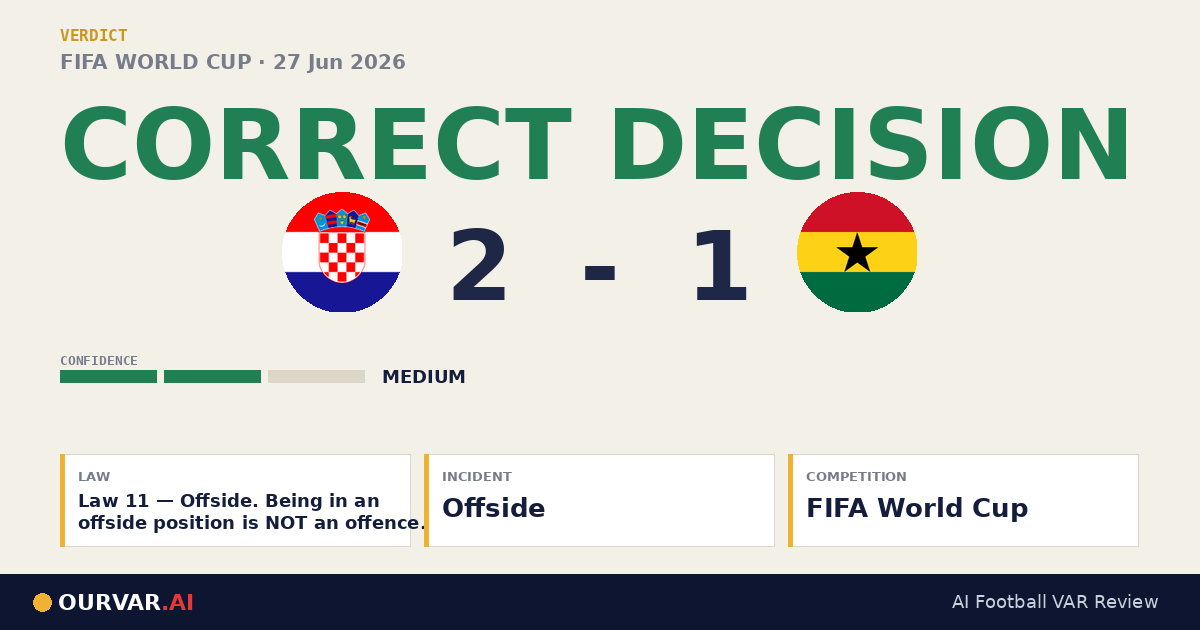
OURVAR judged the referee's decision: Correct. You're voting on whether OURVAR's analysis is right — not on the referee.
Do you agree with OURVAR's verdict?
Every vote helps sharpen OURVAR's accuracy — and we're grateful for it. The AI isn't infallible, and your verdict is exactly what improves it, case by case. You're helping build the VAR we all deserve. 🙏
Ghana equalised against Croatia at 1-1, and after the celebrations the assistant referee flagged for offside, sending the referee to the monitor for nearly four minutes. The goal was correctly given. The decision turns on the most misunderstood principle in Law 11: being in an offside position is NOT an offence. A player is only penalised if he is in an offside position AND becomes involved in active play — by touching the ball, by interfering with an opponent (blocking the goalkeeper's sight or movement, challenging a defender), or by gaining an advantage from a rebound. Here, two things make the goal valid: first, the player who actually scored was ONSIDE; second, Ghana's #8, who was in an offside position, did not touch the ball and did not interfere with any opponent. As the referee stated: "The attacker number 8 was in an offside position, but he did not interfere with play. Decision is goal for Ghana." An offside-positioned teammate who stays passive and out of the play does not invalidate a goal scored by an onside player. CORRECT DECISION, HIGH confidence — and the long check reflects the referee correctly verifying both the scorer's position and whether #8 became active.
Read the full OURVAR breakdown
Sign up to see every key factor, the IFAB law clauses cited, and the frame-by-frame reasoning that led to this verdict.
- Key factors that drove the AI's call
- Full IFAB law citations + frame references
- Vote, comment, and discuss with other fans
Ask OURVAR
Have a question about this verdict?
Push back on the verdict. Ask the AI 'why?', 'what about the elbow angle?', 'what's the precedent?' — and get IFAB-grounded answers from the same model that called the case. Pro 25/month · WC 50 · GB 150.


Discussion