
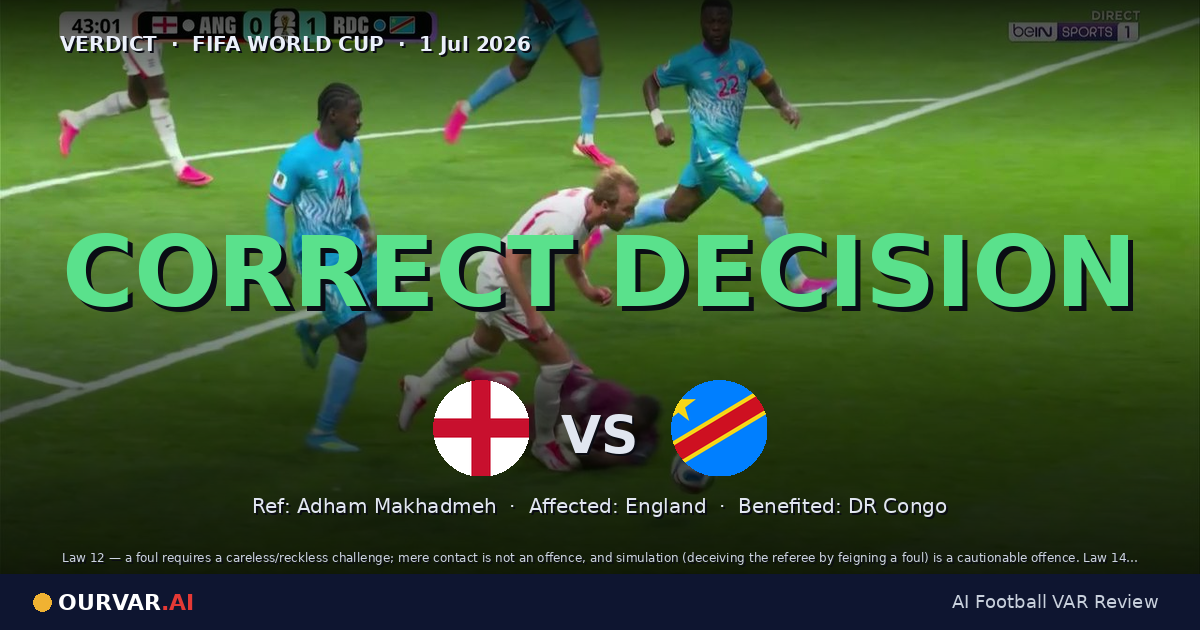
OURVAR judged the referee's decision: Correct. You're voting on whether OURVAR's analysis is right — not on the referee.
Do you agree with OURVAR's verdict?
Every vote helps sharpen OURVAR's accuracy — and we're grateful for it. The AI isn't infallible, and your verdict is exactly what improves it, case by case. You're helping build the VAR we all deserve. 🙏
Just before half-time, trailing DR Congo 1-0, England's Harry Kane went down under a challenge from the onrushing goalkeeper near the edge of the box. The referee instantly signalled a dive and gave no penalty; VAR checked and took no action. This is the correct decision. The principle is the one fans most often get wrong: contact does not equal a penalty. A goalkeeper committing to a slide is not fouling unless he misses the ball and brings the attacker down — and here the contact was minimal and Kane was already falling, so it does not rise to a foul. Two details support the call: the referee, well-placed, read it live as going down too easily; and although he signalled a dive he did not caution Kane, which is the honest middle ground — not enough for a penalty, but not clear-cut simulation either, usually meaning some light contact existed. VAR checking and taking no action confirms there was no clear and obvious error to correct. CORRECT DECISION, medium confidence — with the caveat that if a replay clearly showed the keeper missing the ball and clipping Kane's leg to cause the fall, it would flip to a penalty (and a DOGSO question, most likely a yellow rather than red as the keeper was attempting to play the ball in his own area). On the available angles, it does not.
Read the full OURVAR breakdown
Sign up to see every key factor, the IFAB law clauses cited, and the frame-by-frame reasoning that led to this verdict.
- Key factors that drove the AI's call
- Full IFAB law citations + frame references
- Vote, comment, and discuss with other fans
Ask OURVAR
Have a question about this verdict?
Push back on the verdict. Ask the AI 'why?', 'what about the elbow angle?', 'what's the precedent?' — and get IFAB-grounded answers from the same model that called the case. Pro 25/month · WC 50 · GB 150.


Discussion