
OURVAR ha giudicato la decisione dell'arbitro: Corretto. Stai votando se l'analisi di OURVAR è corretta — non sull'arbitro.
Sei d'accordo con il verdetto di OURVAR?
Ogni voto aiuta ad affinare la precisione di OURVAR — e te ne siamo grati. L'AI non è infallibile, e il tuo giudizio è esattamente ciò che la migliora, caso per caso. Stai contribuendo a costruire il VAR che tutti meritiamo. 🙏
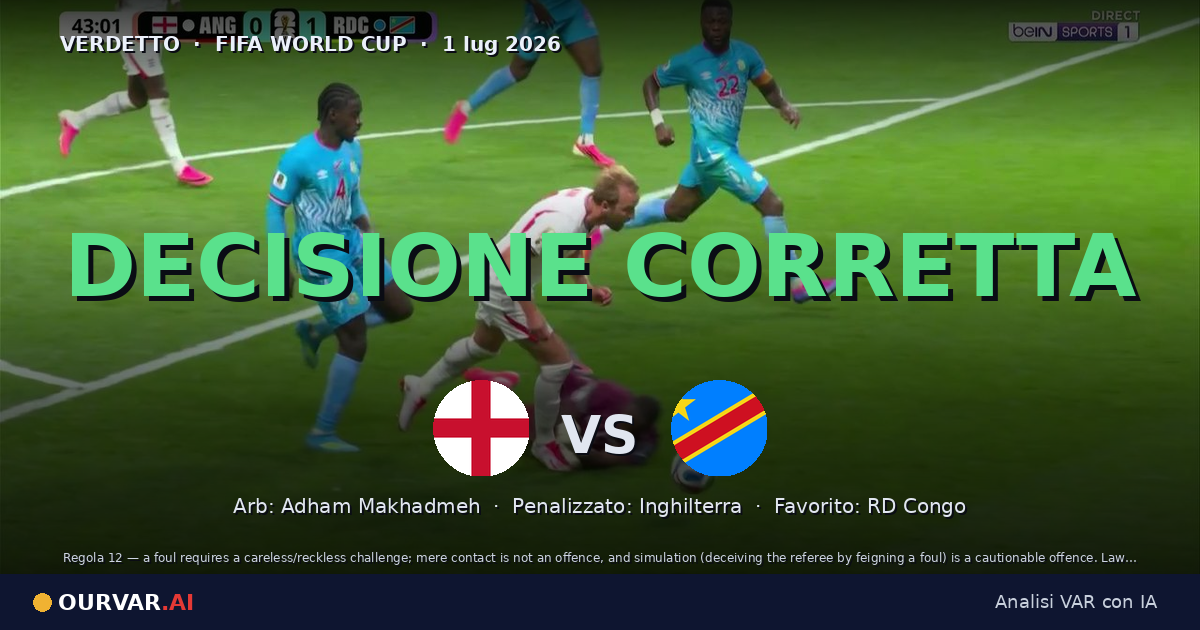
Just before half-time, trailing DR Congo 1-0, England's Harry Kane went down under a challenge from the onrushing goalkeeper near the edge of the box. The referee instantly signalled a dive and gave no penalty; VAR checked and took no action. This is the correct decision. The principle is the one fans most often get wrong: contact does not equal a penalty. A goalkeeper committing to a slide is not fouling unless he misses the ball and brings the attacker down — and here the contact was minimal and Kane was already falling, so it does not rise to a foul. Two details support the call: the referee, well-placed, read it live as going down too easily; and although he signalled a dive he did not caution Kane, which is the honest middle ground — not enough for a penalty, but not clear-cut simulation either, usually meaning some light contact existed. VAR checking and taking no action confirms there was no clear and obvious error to correct. CORRECT DECISION, medium confidence — with the caveat that if a replay clearly showed the keeper missing the ball and clipping Kane's leg to cause the fall, it would flip to a penalty (and a DOGSO question, most likely a yellow rather than red as the keeper was attempting to play the ball in his own area). On the available angles, it does not.
Leggi l'analisi completa di OURVAR
Iscriviti per vedere ogni punto chiave, le clausole IFAB citate e il ragionamento fotogramma per fotogramma dietro questo verdetto.
- Punti chiave che hanno guidato la decisione dell'IA
- Citazioni complete delle Leggi IFAB + riferimenti ai fotogrammi
- Vota, commenta e discuti con altri tifosi
Chiedi a OURVAR
Una domanda su questo verdetto?
Metti in discussione il verdetto. Chiedi all'OURVAR "perché?", "e l'angolo del gomito?", "qual è il precedente?" — e ricevi risposte basate sulle Regole IFAB dallo stesso modello che ha analizzato il caso. Pro 25/mese · WC 50 · GB 150.


Discussione