
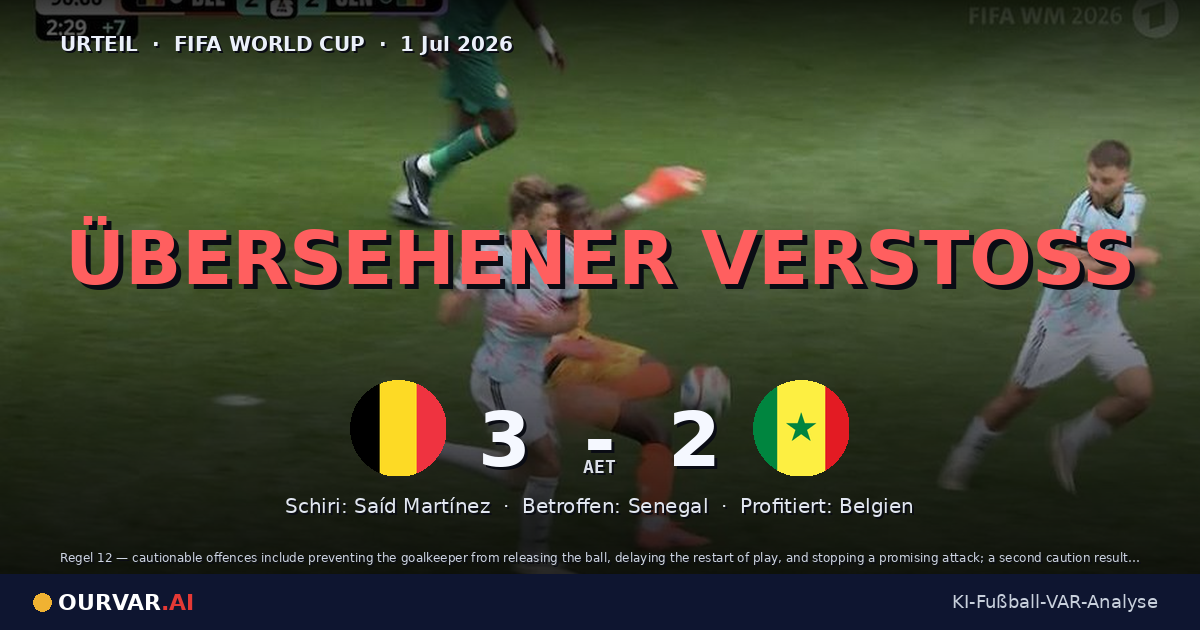
OURVAR hat die Entscheidung des Schiedsrichters bewertet: Falsch (kein Pfiff). Du stimmst darüber ab, ob OURVARs Analyse korrekt ist – nicht über den Schiedsrichter.
Stimmst du mit OURVARs Urteil überein?
Jede Stimme hilft, die Genauigkeit von OURVAR zu verbessern – und wir sind dankbar dafür. Die AI ist nicht unfehlbar, und dein Urteil ist genau das, was sie Fall für Fall verbessert. Du hilfst dabei, den VAR aufzubauen, den wir alle verdienen. 🙏
Belgiens Mechele, bereits mit einer Gelben Karte verwarnt, blockierte/behinderte den Torwart des Senegal beim Freigeben des Balls, um einen schnellen Gegenangriff in der 97. Minute eines 2:2-Knockout-Spiels zu starten. Es wurde keine Karte gezeigt. VAR intervenierte nicht. Belgien gewann in der Verlängerung.
Lies die volle OURVAR-Analyse
Melde dich an, um jeden Schlüsselfaktor, die zitierten IFAB-Regelklauseln und die Bild-für-Bild-Begründung hinter dem Urteil zu sehen.
- Schlüsselfaktoren, die die KI-Entscheidung gelenkt haben
- Vollständige IFAB-Regelzitate + Bildreferenzen
- Stimme ab, kommentiere und diskutiere mit anderen Fans
Frag OURVAR
Eine Frage zu diesem Urteil?
Hinterfrage die Entscheidung. Stelle der KI Folgefragen — „warum?", „wie sieht es mit dem Ellbogenwinkel aus?", „was sagt der Präzedenzfall?" — und erhalte IFAB-gestützte Antworten vom selben Modell, das den Fall bewertet hat. Pro 25/Monat · WC 50 · GB 150.


Diskussion