
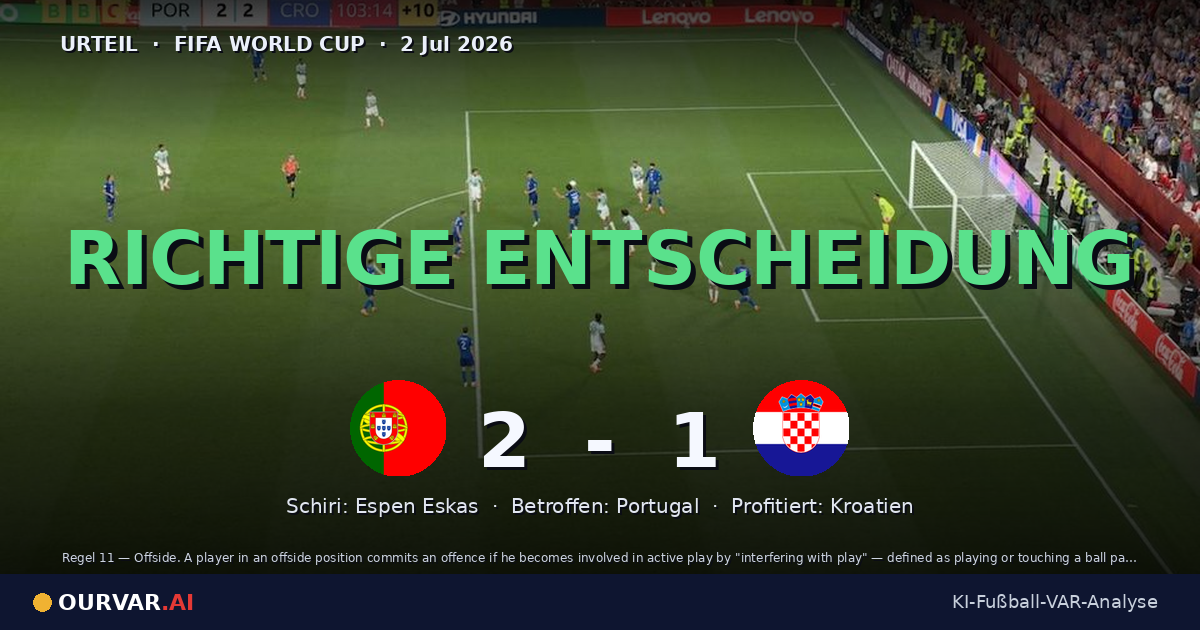
OURVAR hat die Entscheidung des Schiedsrichters bewertet: Korrekt. Du stimmst darüber ab, ob OURVARs Analyse korrekt ist – nicht über den Schiedsrichter.
Stimmst du mit OURVARs Urteil überein?
Jede Stimme hilft, die Genauigkeit von OURVAR zu verbessern – und wir sind dankbar dafür. Die AI ist nicht unfehlbar, und dein Urteil ist genau das, was sie Fall für Fall verbessert. Du hilfst dabei, den VAR aufzubauen, den wir alle verdienen. 🙏
Deep in extra time at 2-2, Croatia scored what looked like a dramatic equaliser against Portugal. The referee gave the goal, but VAR disallowed it for offside after checking connected-ball sensor data — and the reason is a subtle but exact application of Law 11. The player who delivered the final cross (#15) was onside. However, a different Croatian player, in an offside position, brushed the ball as it passed him — a contact on his hair or the top of his head, invisible to the naked eye but registered by the sensor inside the match ball. Under Law 11, a player in an offside position who touches a ball played by a teammate is "interfering with play," and that is an offside offence. Crucially, any touch qualifies: it does not need to change the ball's direction, and it does not need to be deliberate. So the offence was complete the moment the offside player made contact, regardless of what happened afterwards or of #15 being onside. This is a factual, objective determination — like goal-line technology — not a subjective judgement: the sensor either detected a touch or it didn't, and it did. CORRECT DECISION, high confidence. Brutal for Croatia, erased by a touch no human could have seen, but exactly right.
Lies die volle OURVAR-Analyse
Melde dich an, um jeden Schlüsselfaktor, die zitierten IFAB-Regelklauseln und die Bild-für-Bild-Begründung hinter dem Urteil zu sehen.
- Schlüsselfaktoren, die die KI-Entscheidung gelenkt haben
- Vollständige IFAB-Regelzitate + Bildreferenzen
- Stimme ab, kommentiere und diskutiere mit anderen Fans
Frag OURVAR
Eine Frage zu diesem Urteil?
Hinterfrage die Entscheidung. Stelle der KI Folgefragen — „warum?", „wie sieht es mit dem Ellbogenwinkel aus?", „was sagt der Präzedenzfall?" — und erhalte IFAB-gestützte Antworten vom selben Modell, das den Fall bewertet hat. Pro 25/Monat · WC 50 · GB 150.


Diskussion