
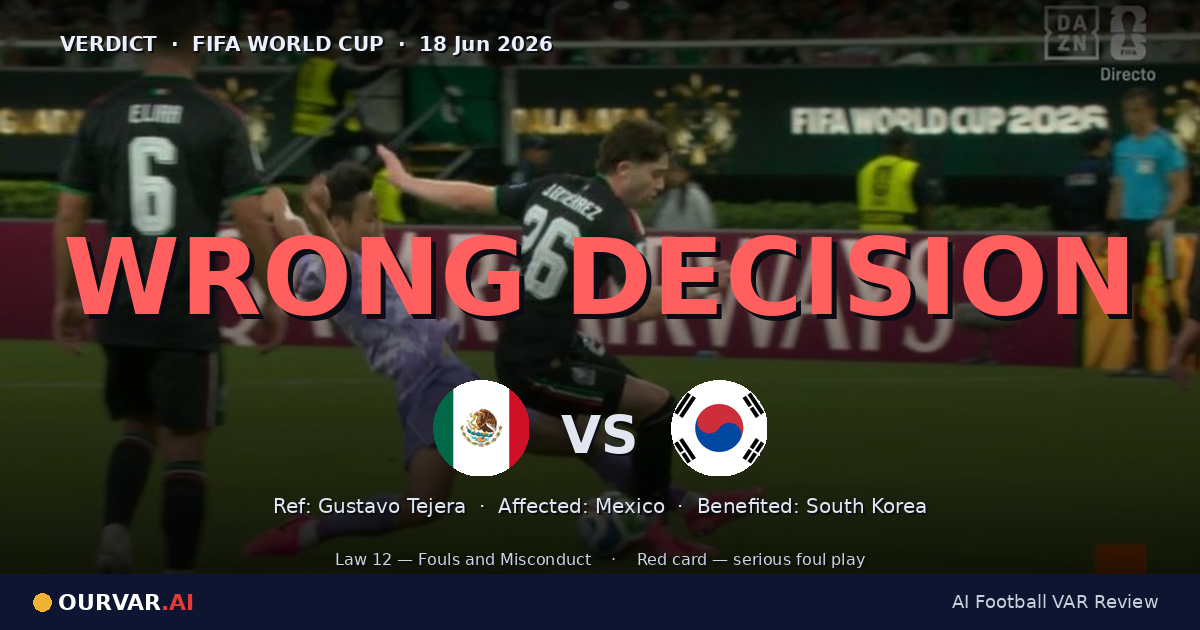
OURVAR judged the referee's decision: Wrong. You're voting on whether OURVAR's analysis is right — not on the referee.
Do you agree with OURVAR's verdict?
Every vote helps sharpen OURVAR's accuracy — and we're grateful for it. The AI isn't infallible, and your verdict is exactly what improves it, case by case. You're helping build the VAR we all deserve. 🙏
A South Korea player (identified in the context as Paik Seung-ho, in purple) slid in on Mexico's #26 with both legs in a scissors motion, clamping around the lower legs and ankles rather than connecting cleanly with the ball. The frames show the ball already separated from the contact zone by the time the legs lock around the Mexico player's ankles, and the follow-through creates visible torque on the ankle joint. Under IFAB Law 12, a scissors challenge that makes player-not-ball contact and bends an opponent's ankle joint crosses from reckless (yellow) into serious foul play that endangers the safety of the opponent (red). The referee showed a yellow card, which is an understatement of the severity — this challenge meets the red-card threshold for serious foul play, and at a FIFA World Cup match where FIFA's own briefings emphasise strict application of these criteria, the yellow card was the wrong call.
Read the full OURVAR breakdown
Sign up to see every key factor, the IFAB law clauses cited, and the frame-by-frame reasoning that led to this verdict.
- Key factors that drove the AI's call
- Full IFAB law citations + frame references
- Vote, comment, and discuss with other fans
Ask OURVAR
Have a question about this verdict?
Push back on the verdict. Ask the AI 'why?', 'what about the elbow angle?', 'what's the precedent?' — and get IFAB-grounded answers from the same model that called the case. Pro 25/month · WC 50 · GB 150.


Discussion