
OURVAR judged the referee's decision: Correct. You're voting on whether OURVAR's analysis is right — not on the referee.
Do you agree with OURVAR's verdict?
Every vote helps sharpen OURVAR's accuracy — and we're grateful for it. The AI isn't infallible, and your verdict is exactly what improves it, case by case. You're helping build the VAR we all deserve. 🙏
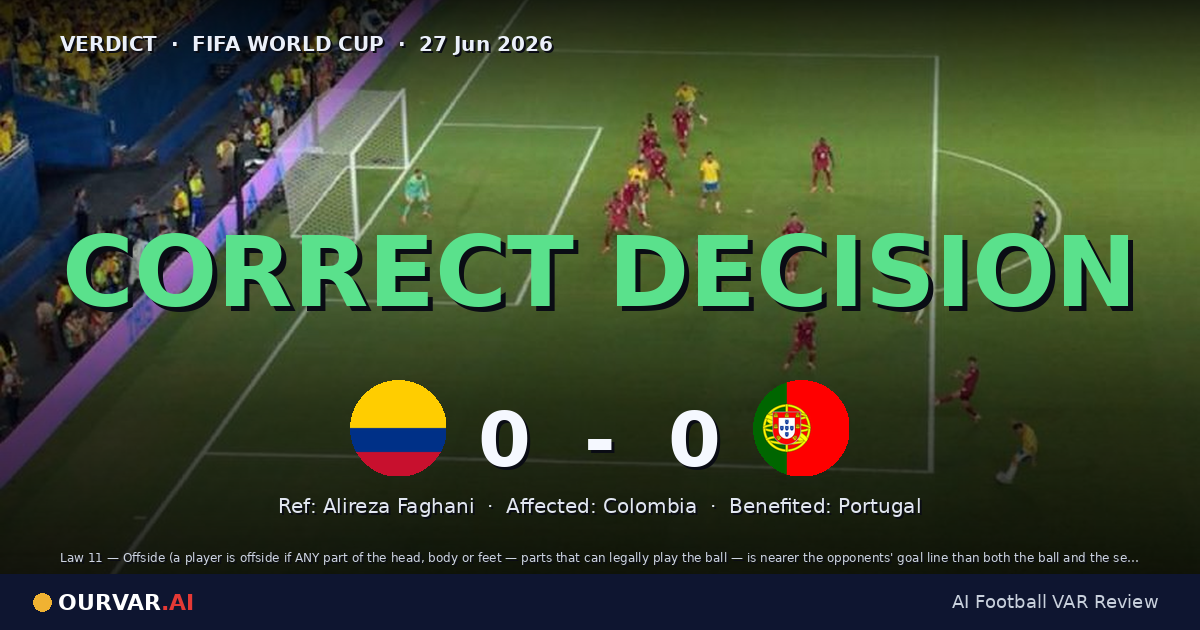
In the fifth minute of stoppage time at 0-0, Colombia's #23 scored what looked like a winner against Portugal. The goal was awarded, then overturned by VAR after semi-automated offside technology (SAOT) found #23 offside by the narrowest of margins — a "toenail." The decision is correct, however brutal. Offside is binary: there is no tolerance, no benefit of the doubt, and no requirement for "clear daylight" — that was only ever a naked-eye guideline for assistant referees, never a law. A toenail beyond the line is offside, full stop, and because it's a foot (a body part that can legally play the ball) it counts toward the line. Crucially, offside is a FACTUAL decision, like goal-line technology — it is NOT gated by the "clear and obvious error" bar that protects subjective calls, so "it's only a toenail, that's not clear and obvious" does not apply. SAOT is the objective arbiter; if it says offside, the goal must be disallowed regardless of margin. CORRECT DECISION, HIGH confidence. The genuine debate here isn't refereeing — it's whether you trust SAOT's precision at toenail scale. That's a technology-trust question, not an officiating error.
Read the full OURVAR breakdown
Sign up to see every key factor, the IFAB law clauses cited, and the frame-by-frame reasoning that led to this verdict.
- Key factors that drove the AI's call
- Full IFAB law citations + frame references
- Vote, comment, and discuss with other fans
Ask OURVAR
Have a question about this verdict?
Push back on the verdict. Ask the AI 'why?', 'what about the elbow angle?', 'what's the precedent?' — and get IFAB-grounded answers from the same model that called the case. Pro 25/month · WC 50 · GB 150.


Discussion