
OURVAR judged the referee's decision: Correct. You're voting on whether OURVAR's analysis is right — not on the referee.
Do you agree with OURVAR's verdict?
Every vote helps sharpen OURVAR's accuracy — and we're grateful for it. The AI isn't infallible, and your verdict is exactly what improves it, case by case. You're helping build the VAR we all deserve. 🙏
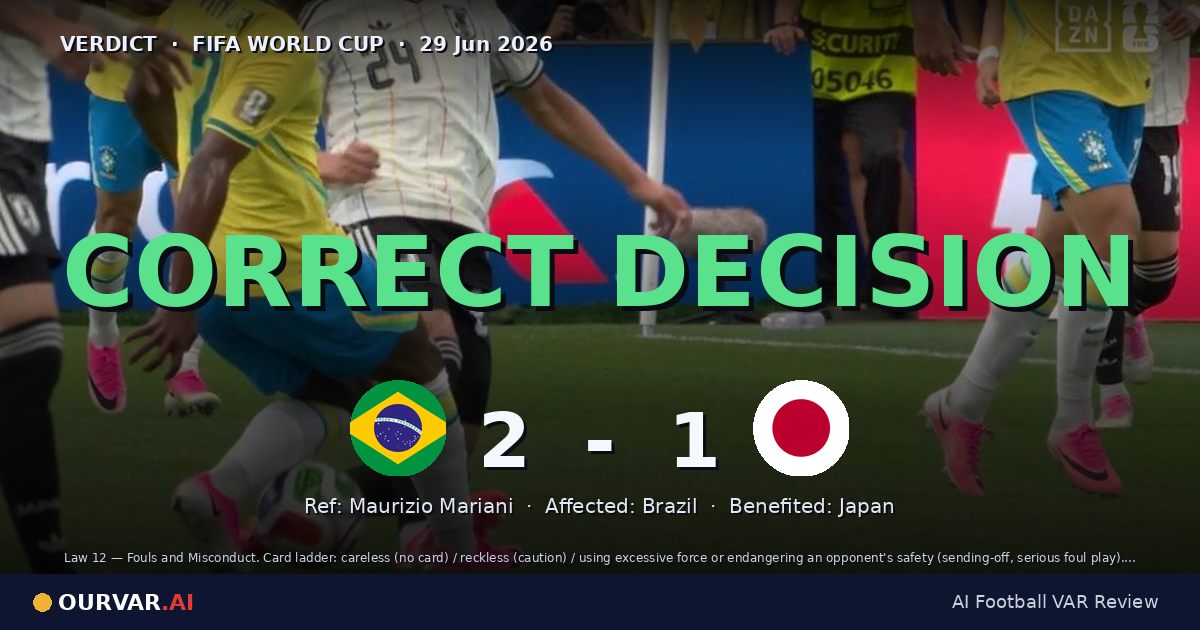
Japan's #24 caught Vinicius with a studs-involved challenge near the touchline. The referee showed a yellow card, and VAR checked for serious foul play but did not intervene, so the yellow stood. Some analysts argued for a straight red, citing studs into the ankle and the joint bending under force. The decision is defensible — and, crucially, VAR was right to stay out. Under Law 12 the difference between a yellow and a red here is force and safety-endangerment: a reckless challenge is a caution, while excessive force or endangering an opponent's safety is a red. The challenge is at least reckless (clear yellow). Whether it crosses into serious foul play depends entirely on whether the studs were planted into the ankle and twisted the joint under force — a genuinely arguable, borderline judgment. And that is exactly the point: VAR's role is not to pick the better call but to correct clear and obvious errors. A challenge the referee saw live and judged reckless, sitting in a real yellow/red grey zone, is by definition not a clear and obvious error — so VAR correctly declined to upgrade it. CORRECT DECISION, MEDIUM confidence. The one thing that would flip this to a red (and make the yellow an undercall) is clear replay evidence of the studs digging in and bending the ankle under force.
Read the full OURVAR breakdown
Sign up to see every key factor, the IFAB law clauses cited, and the frame-by-frame reasoning that led to this verdict.
- Key factors that drove the AI's call
- Full IFAB law citations + frame references
- Vote, comment, and discuss with other fans
Ask OURVAR
Have a question about this verdict?
Push back on the verdict. Ask the AI 'why?', 'what about the elbow angle?', 'what's the precedent?' — and get IFAB-grounded answers from the same model that called the case. Pro 25/month · WC 50 · GB 150.


Discussion