
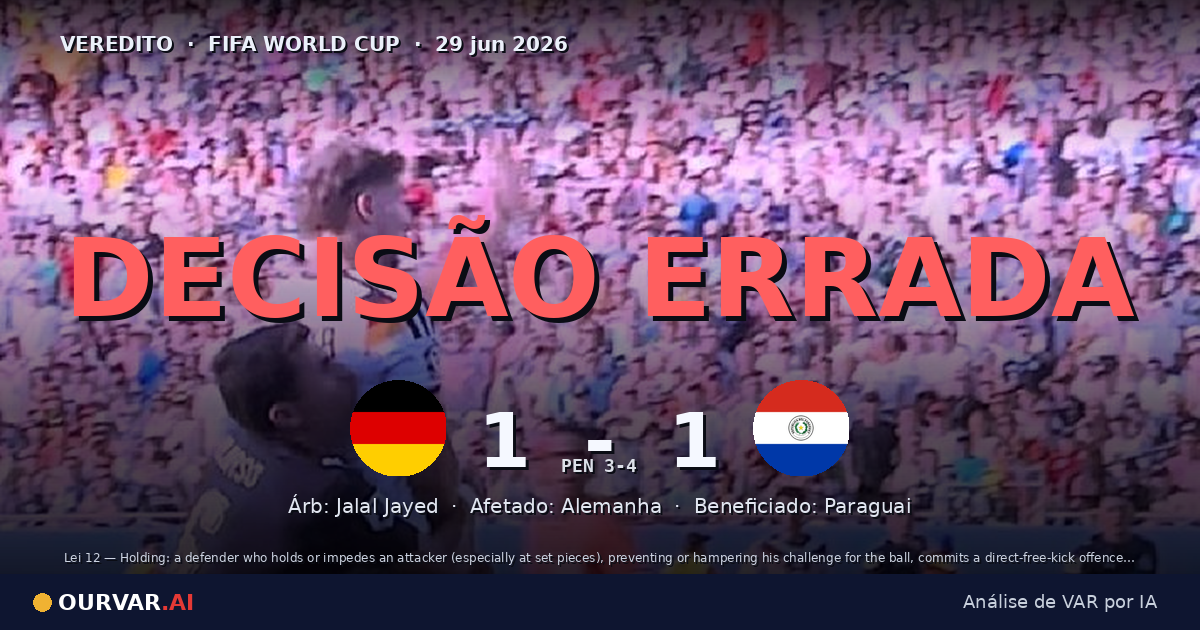
O OURVAR julgou a decisão do árbitro: Errado. Você está votando se a análise do OURVAR está correta — não sobre o árbitro.
Você concorda com o veredicto do OURVAR?
Cada voto ajuda a aprimorar a precisão do OURVAR — e somos gratos por isso. A AI não é infalível, e o seu veredicto é exatamente o que a melhora, caso a caso. Você está ajudando a construir o VAR que todos merecemos. 🙏
At a Germany corner in the same match in which Germany's goal was later disallowed for a foul on the Paraguay goalkeeper, a Paraguay defender held and impeded Germany's Goretzka in the penalty area. No foul was given and VAR did not intervene. This is a wrong decision — and the way to see it clearly is to apply the exact standard VAR itself used to disallow Germany's goal. That disallowance treated marginal attacker-on-keeper contact at a set piece as a punishable, VAR-worthy foul. By that same standard, a defender restraining an attacker with an arm across his body is a clear holding offence and a penalty. The point is not that this is a nailed-on penalty in isolation — corner-box grappling is often allowed to go. The point is consistency: a defender can only justify this non-call by appealing to a lenient "let it all go" standard, but that same lenient standard would have meant Germany's goal should have stood. VAR applied a strict standard against Germany at one end and a lenient standard for Paraguay at the other, in the same match, on the same type of set-piece contact. That asymmetry — punishing the murkier foul, ignoring the clearer one — is the indefensible part. WRONG DECISION, medium confidence: a comparable-or-clearer foul left un-actioned by a VAR that intervened for less at the other end.
Leia a análise completa da OURVAR
Cadastre-se para ver cada ponto-chave, as cláusulas das Leis IFAB citadas e o raciocínio quadro a quadro que levou a este veredito.
- Pontos-chave que orientaram a decisão da IA
- Citações completas das Leis IFAB + referências de quadros
- Vote, comente e discuta com outros fãs
Pergunte à OURVAR
Alguma dúvida sobre este veredito?
Questione o veredito. Pergunte ao OURVAR "por quê?", "e o ângulo do cotovelo?", "qual o precedente?" — e receba respostas fundamentadas nas Leis da IFAB do mesmo modelo que analisou o lance. Pro 25/mês · WC 50 · GB 150.


Discussão