
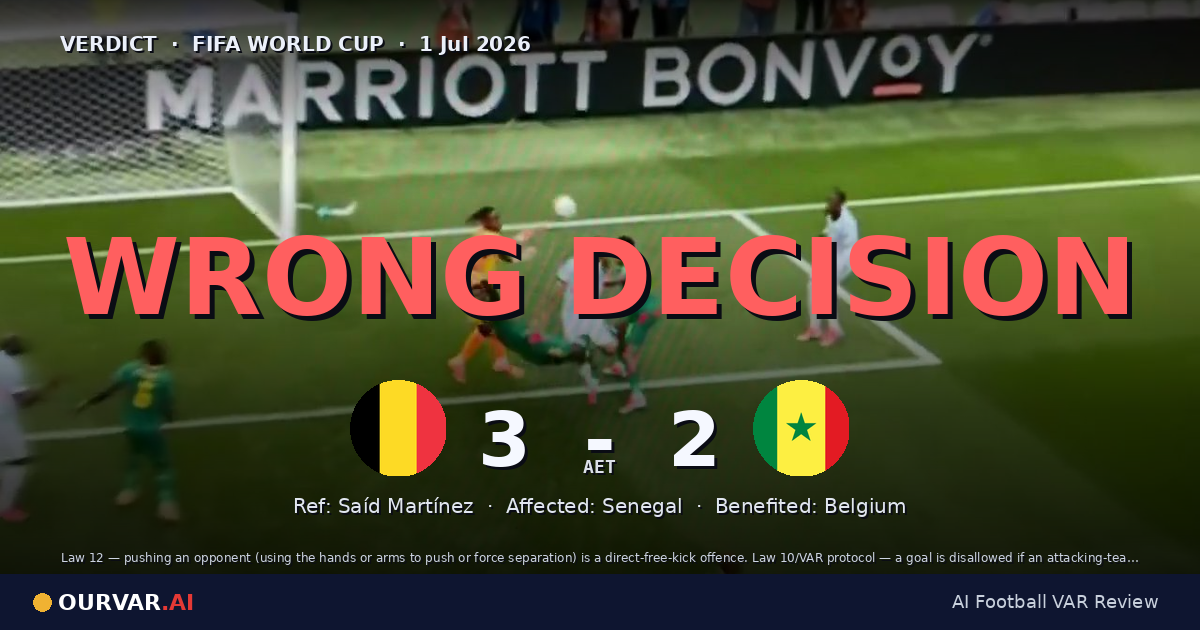
OURVAR judged the referee's decision: Wrong. You're voting on whether OURVAR's analysis is right — not on the referee.
Do you agree with OURVAR's verdict?
Every vote helps sharpen OURVAR's accuracy — and we're grateful for it. The AI isn't infallible, and your verdict is exactly what improves it, case by case. You're helping build the VAR we all deserve. 🙏
Belgium scored a late equaliser against Senegal from a cross to force extra time, which they went on to win on a penalty. The goal should not have stood. Replays show the scorer using both hands to push two Senegal defenders apart while they were looking up at the ball — a clear, one-sided push, not the mutual jostling that is tolerated at set pieces. Pushing an opponent is a direct-free-kick offence, and when an attacking foul creates the goal, the goal must be disallowed. This is not a case of penalising every touch in a crowded box: the distinction is that the defenders were passive and ball-watching while the attacker actively shoved them to make his space. VAR checks every goal, so it either missed the push or wrongly judged it insufficient — a clear attacking foul in the immediate build-up is exactly what VAR exists to catch. WRONG DECISION, medium-high confidence. The one qualifier: it rests on the push being clear and one-sided and materially creating the chance, which the available frames support; if the defenders were also pushing, it would soften toward a scramble, but they are shown watching the ball, not wrestling.
Read the full OURVAR breakdown
Sign up to see every key factor, the IFAB law clauses cited, and the frame-by-frame reasoning that led to this verdict.
- Key factors that drove the AI's call
- Full IFAB law citations + frame references
- Vote, comment, and discuss with other fans
Ask OURVAR
Have a question about this verdict?
Push back on the verdict. Ask the AI 'why?', 'what about the elbow angle?', 'what's the precedent?' — and get IFAB-grounded answers from the same model that called the case. Pro 25/month · WC 50 · GB 150.


Discussion