
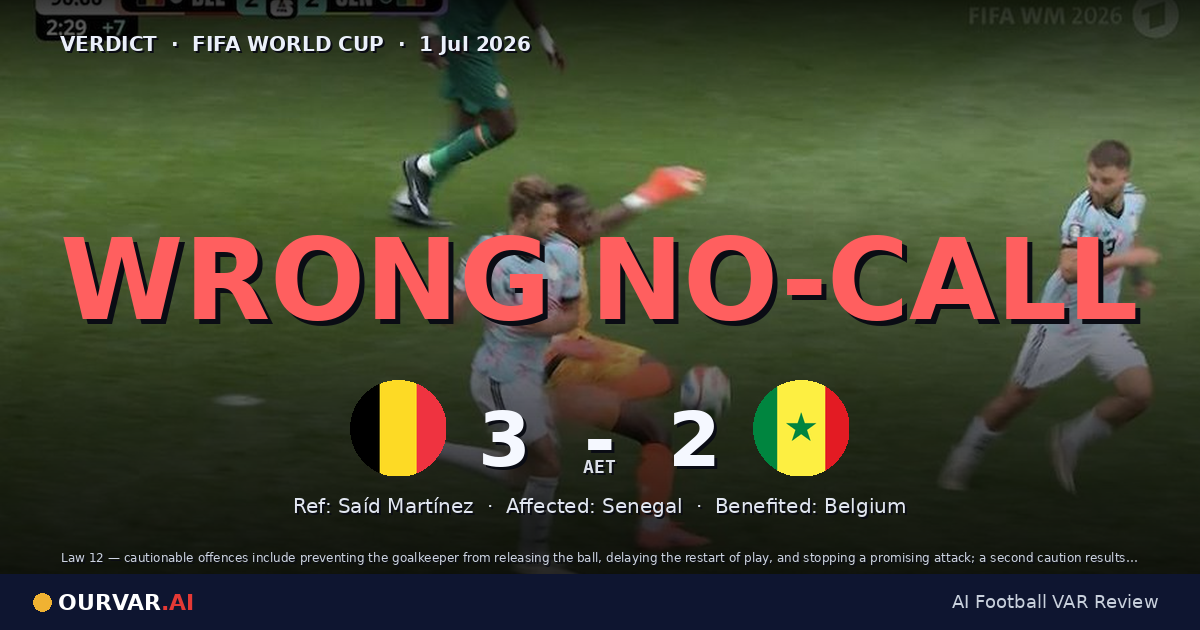
OURVAR judged the referee's decision: Wrong (No Call). You're voting on whether OURVAR's analysis is right — not on the referee.
Do you agree with OURVAR's verdict?
Every vote helps sharpen OURVAR's accuracy — and we're grateful for it. The AI isn't infallible, and your verdict is exactly what improves it, case by case. You're helping build the VAR we all deserve. 🙏
In the 97th minute of a 2-2 knockout tie, Belgium's Mechele — already on a yellow card — blocked the Senegal goalkeeper from releasing the ball to launch a quick counter-attack. The referee showed no card, and VAR did not intervene; Belgium won in extra time. The correct call on the field was a second yellow and a sending-off: preventing the keeper's release, delaying the restart, and stopping a promising attack are all cautionable offences, and a second caution is a red. So the referee made a clear on-field error, with real consequences — Belgium should have finished the tie and played extra time a man down. However, VAR's non-intervention was correct and unavoidable. The 2026 rules did expand VAR's remit to second yellow cards, but only in one direction: VAR may overturn a second yellow that was wrongly awarded, and is expressly not permitted to recommend or add a second yellow that the referee did not show. Because no card was given, there was nothing for VAR to overturn, and adding the missed booking is outside its power. This is therefore a refereeing error that VAR had no authority to fix — not a VAR failure. WRONG DECISION (on-field), medium-high confidence.
Read the full OURVAR breakdown
Sign up to see every key factor, the IFAB law clauses cited, and the frame-by-frame reasoning that led to this verdict.
- Key factors that drove the AI's call
- Full IFAB law citations + frame references
- Vote, comment, and discuss with other fans
Ask OURVAR
Have a question about this verdict?
Push back on the verdict. Ask the AI 'why?', 'what about the elbow angle?', 'what's the precedent?' — and get IFAB-grounded answers from the same model that called the case. Pro 25/month · WC 50 · GB 150.


Discussion