
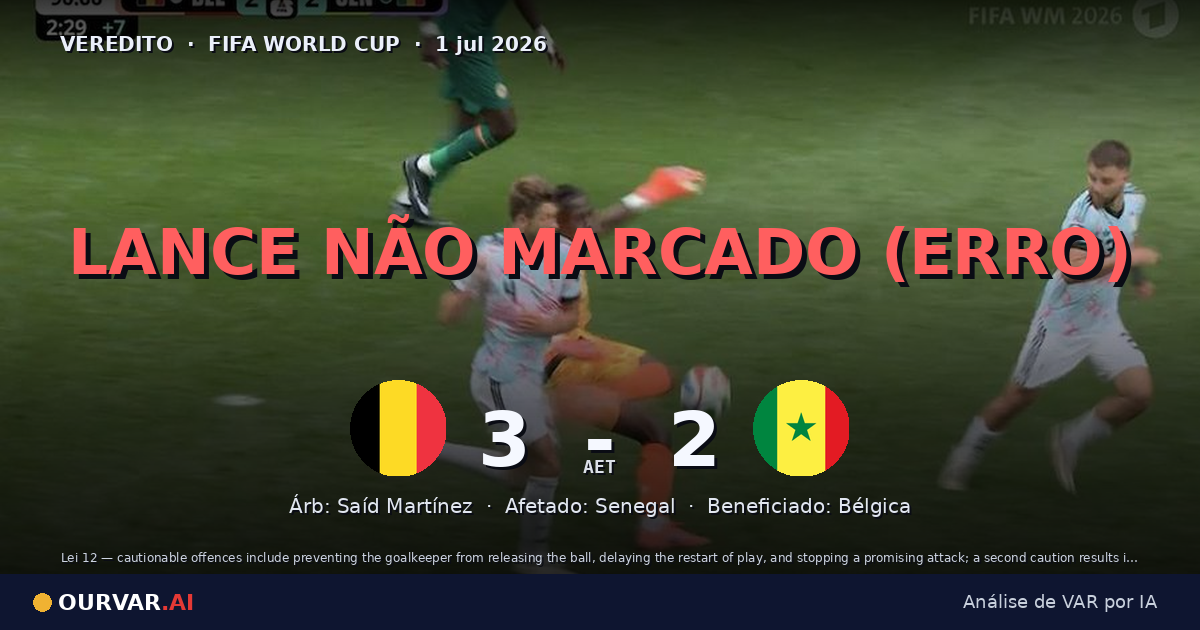
O OURVAR julgou a decisão do árbitro: Errado (sem marcação). Você está votando se a análise do OURVAR está correta — não sobre o árbitro.
Você concorda com o veredicto do OURVAR?
Cada voto ajuda a aprimorar a precisão do OURVAR — e somos gratos por isso. A AI não é infalível, e o seu veredicto é exatamente o que a melhora, caso a caso. Você está ajudando a construir o VAR que todos merecemos. 🙏
In the 97th minute of a 2-2 knockout tie, Belgium's Mechele — already on a yellow card — blocked the Senegal goalkeeper from releasing the ball to launch a quick counter-attack. The referee showed no card, and VAR did not intervene; Belgium won in extra time. The correct call on the field was a second yellow and a sending-off: preventing the keeper's release, delaying the restart, and stopping a promising attack are all cautionable offences, and a second caution is a red. So the referee made a clear on-field error, with real consequences — Belgium should have finished the tie and played extra time a man down. However, VAR's non-intervention was correct and unavoidable. The 2026 rules did expand VAR's remit to second yellow cards, but only in one direction: VAR may overturn a second yellow that was wrongly awarded, and is expressly not permitted to recommend or add a second yellow that the referee did not show. Because no card was given, there was nothing for VAR to overturn, and adding the missed booking is outside its power. This is therefore a refereeing error that VAR had no authority to fix — not a VAR failure. WRONG DECISION (on-field), medium-high confidence.
Leia a análise completa da OURVAR
Cadastre-se para ver cada ponto-chave, as cláusulas das Leis IFAB citadas e o raciocínio quadro a quadro que levou a este veredito.
- Pontos-chave que orientaram a decisão da IA
- Citações completas das Leis IFAB + referências de quadros
- Vote, comente e discuta com outros fãs
Pergunte à OURVAR
Alguma dúvida sobre este veredito?
Questione o veredito. Pergunte ao OURVAR "por quê?", "e o ângulo do cotovelo?", "qual o precedente?" — e receba respostas fundamentadas nas Leis da IFAB do mesmo modelo que analisou o lance. Pro 25/mês · WC 50 · GB 150.


Discussão