
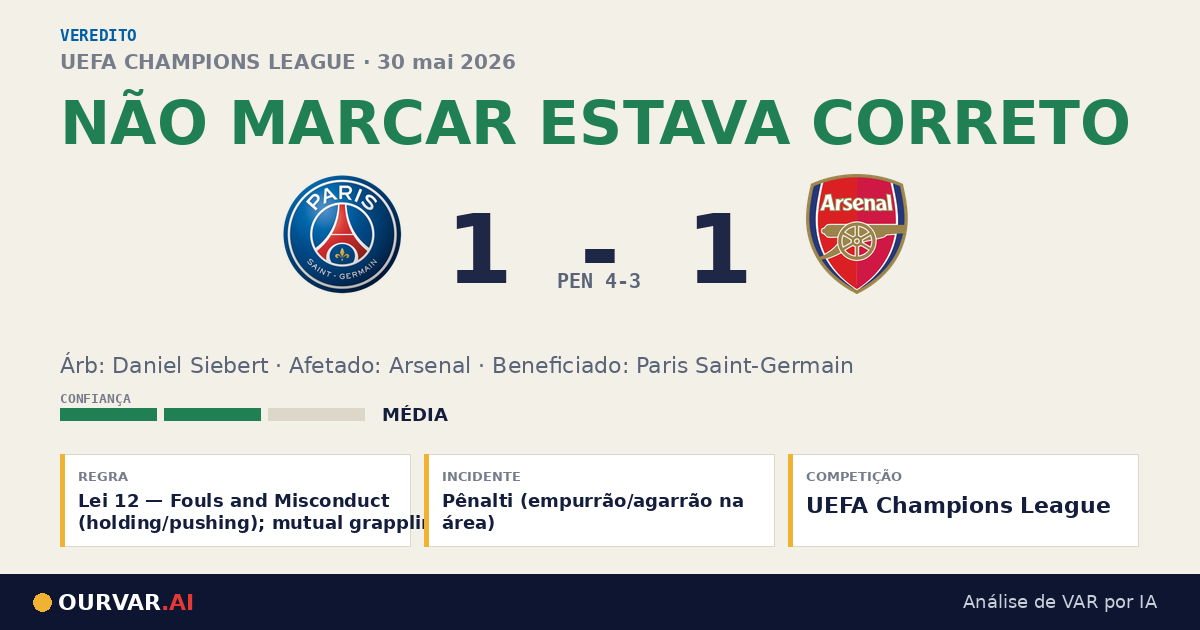
O OURVAR julgou a decisão do árbitro: Correto (sem marcação). Você está votando se a análise do OURVAR está correta — não sobre o árbitro.
Você concorda com o veredicto do OURVAR?
Cada voto ajuda a aprimorar a precisão do OURVAR — e somos gratos por isso. A AI não é infalível, e o seu veredicto é exatamente o que a melhora, caso a caso. Você está ajudando a construir o VAR que todos merecemos. 🙏
In this incident, Arsenal's striker went to ground in the Paris Saint-Germain penalty area and demanded a penalty kick — one of the most controversial moments of the match. The referee let play continue, and based on what the frames show, that was the correct call. Looking at the build-up, both players had their arms in contact with each other from the start, and crucially, the Arsenal attacker can be seen wrapping/hooking his own arm around the PSG defender's — meaning the grappling was clearly two-way, not a one-sided hold by the defender. Under the Laws of the Game, mutual wrestling in the penalty area does not automatically produce a penalty; the defender's contact must be the primary cause of the fall. Here it wasn't: both players were restraining each other, and the fall was the product of shared balance disruption rather than a clear shove or grab from PSG. The play-on was the right decision, even given UEFA's generally tighter standard for box contact.
Leia a análise completa da OURVAR
Cadastre-se para ver cada ponto-chave, as cláusulas das Leis IFAB citadas e o raciocínio quadro a quadro que levou a este veredito.
- Pontos-chave que orientaram a decisão da IA
- Citações completas das Leis IFAB + referências de quadros
- Vote, comente e discuta com outros fãs
Pergunte à OURVAR
Alguma dúvida sobre este veredito?
Questione o veredito. Pergunte ao OURVAR "por quê?", "e o ângulo do cotovelo?", "qual o precedente?" — e receba respostas fundamentadas nas Leis da IFAB do mesmo modelo que analisou o lance. Pro 25/mês · WC 50 · GB 150.


Discussão