
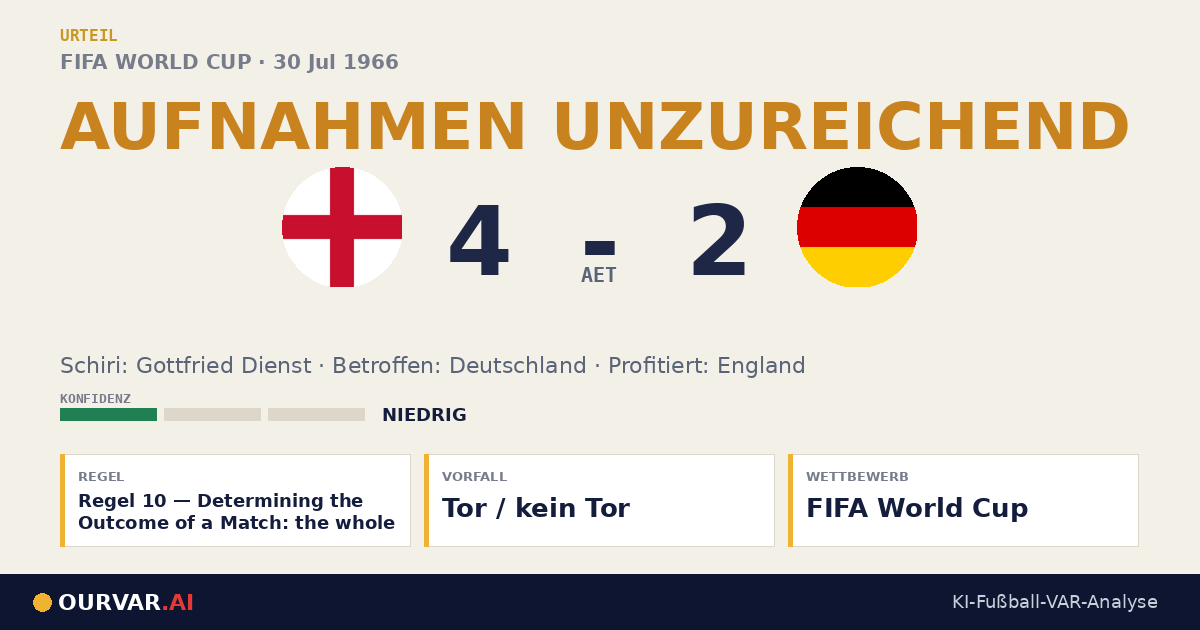
OURVAR hat die Entscheidung des Schiedsrichters bewertet: Unzureichendes Material. Du stimmst darüber ab, ob OURVARs Analyse korrekt ist – nicht über den Schiedsrichter.
Stimmst du mit OURVARs Urteil überein?
Jede Stimme hilft, die Genauigkeit von OURVAR zu verbessern – und wir sind dankbar dafür. Die AI ist nicht unfehlbar, und dein Urteil ist genau das, was sie Fall für Fall verbessert. Du hilfst dabei, den VAR aufzubauen, den wir alle verdienen. 🙏
This is the legendary "Wembley goal" from the 1966 FIFA World Cup Final, one of football's most contested decisions. Referee Gottfried Dienst — after consulting his Soviet linesman Tofiq Bahramov — allowed the goal for England, making the score 3-2 at the time. Under the Laws of the Game, the decision is simple in principle: the *whole* ball must cross the *whole* goal line. The problem is that these seven broadcast frames, taken from a high side-on camera angle with 1966-era resolution, simply cannot confirm or deny whether that happened at the critical instant. No frame captures the ball fully inside the net or fully outside; only the aftermath — Germany's #2 reacting near the post, players on the ground, the goalkeeper having dived — is visible. Based purely on what can be seen here, a verdict of **INSUFFICIENT FOOTAGE** is the only honest call. For context, a 2016 scientific reconstruction by Oxford University using photogrammetric analysis concluded the ball very likely did *not* fully cross the line — meaning Germany were probably the affected party — but that conclusion cannot be reached from these frames alone.
Lies die volle OURVAR-Analyse
Melde dich an, um jeden Schlüsselfaktor, die zitierten IFAB-Regelklauseln und die Bild-für-Bild-Begründung hinter dem Urteil zu sehen.
- Schlüsselfaktoren, die die KI-Entscheidung gelenkt haben
- Vollständige IFAB-Regelzitate + Bildreferenzen
- Stimme ab, kommentiere und diskutiere mit anderen Fans
Frag OURVAR
Eine Frage zu diesem Urteil?
Hinterfrage die Entscheidung. Stelle der KI Folgefragen — „warum?", „wie sieht es mit dem Ellbogenwinkel aus?", „was sagt der Präzedenzfall?" — und erhalte IFAB-gestützte Antworten vom selben Modell, das den Fall bewertet hat. Pro 25/Monat · WC 50 · GB 150.


Diskussion