
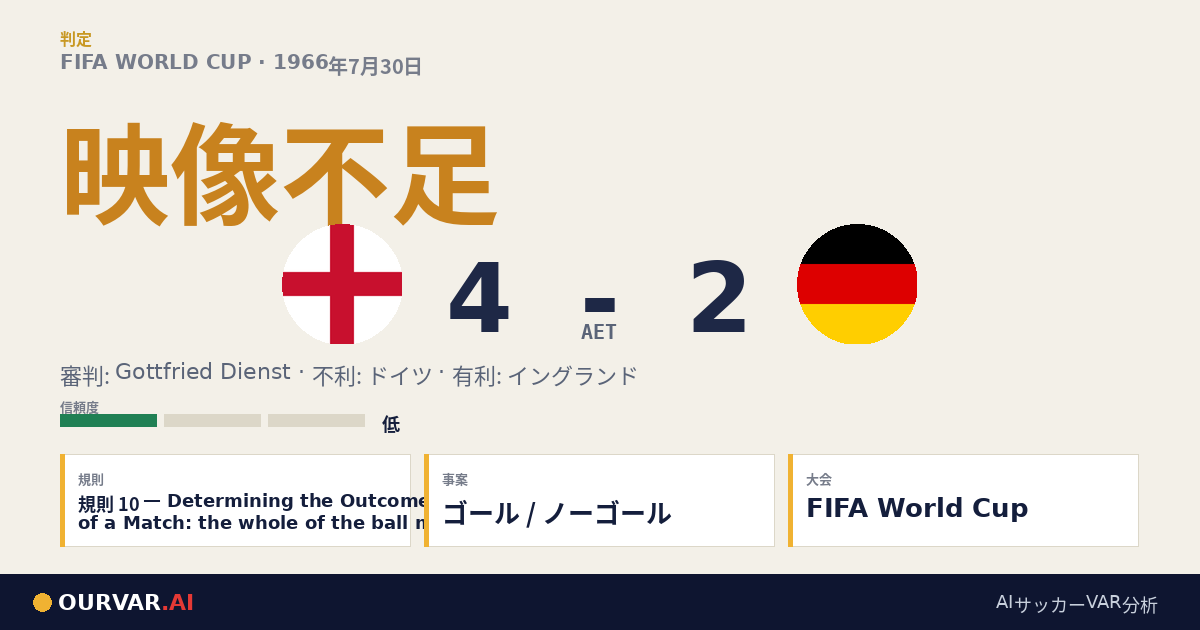
OURVARは審判の判定を「映像不足」と分析しました。あなたが投票するのは、OURVARの分析が正しいかどうかです。審判への投票ではありません。
OURVARの判定に同意しますか?
すべての投票がOURVARの精度向上に役立っています — そのご協力に心より感謝します。AIは完璧ではなく、皆さんの判定こそがケースごとの改善につながります。私たちが求めるVARを、一緒に作り上げていきましょう。🙏
This is the legendary "Wembley goal" from the 1966 FIFA World Cup Final, one of football's most contested decisions. Referee Gottfried Dienst — after consulting his Soviet linesman Tofiq Bahramov — allowed the goal for England, making the score 3-2 at the time. Under the Laws of the Game, the decision is simple in principle: the *whole* ball must cross the *whole* goal line. The problem is that these seven broadcast frames, taken from a high side-on camera angle with 1966-era resolution, simply cannot confirm or deny whether that happened at the critical instant. No frame captures the ball fully inside the net or fully outside; only the aftermath — Germany's #2 reacting near the post, players on the ground, the goalkeeper having dived — is visible. Based purely on what can be seen here, a verdict of **INSUFFICIENT FOOTAGE** is the only honest call. For context, a 2016 scientific reconstruction by Oxford University using photogrammetric analysis concluded the ball very likely did *not* fully cross the line — meaning Germany were probably the affected party — but that conclusion cannot be reached from these frames alone.
OURVARの完全分析を読む
重要ポイント、引用されたIFAB競技規則、判定に至るまでのフレーム毎の解説をすべて見るには登録してください。
- AIの判定を導いた重要ポイント
- IFAB規則の完全引用 + フレーム参照
- 投票、コメント、他のファンと議論
OURVARに質問
この判定について質問はありますか?
判定に異議を唱えよう。OURVARに「なぜ?」「肘の角度は?」「前例は?」と質問し、ケースを分析した同じモデルからIFAB規則に基づいた回答を受け取れます。Pro 25/月 · WC 50 · GB 150.


ディスカッション