
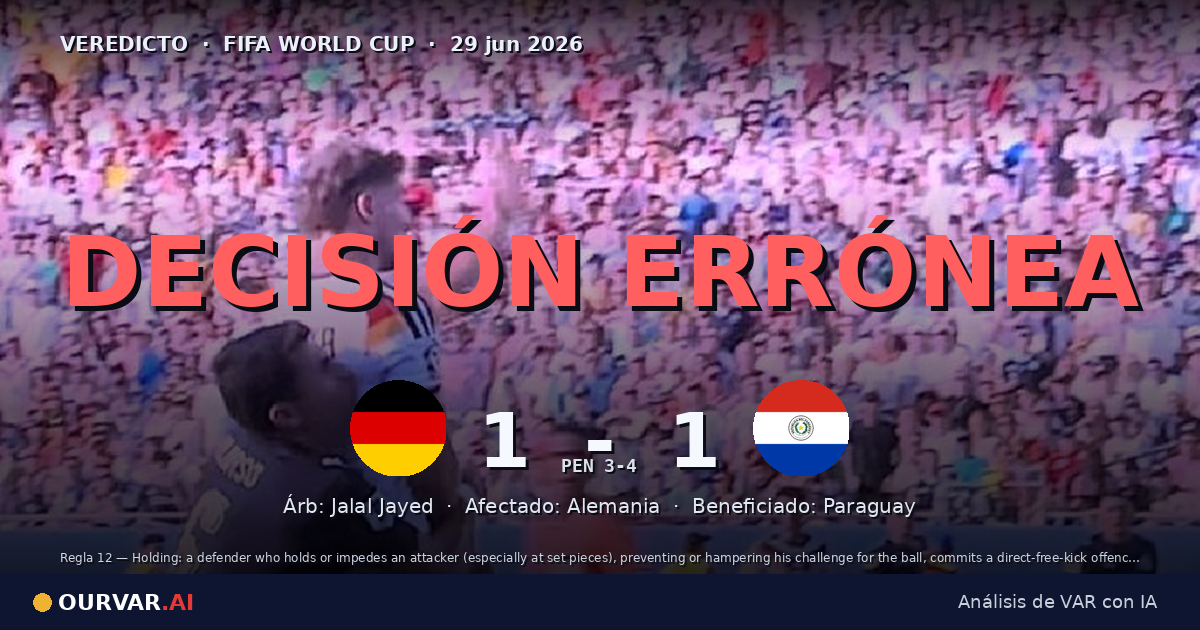
OURVAR ha juzgado la decisión del árbitro: Incorrecto. Estás votando si el análisis de OURVAR es correcto, no sobre el árbitro.
¿Estás de acuerdo con el veredicto de OURVAR?
Cada voto ayuda a afinar la precisión de OURVAR — y te lo agradecemos. La AI no es infalible, y tu veredicto es exactamente lo que la mejora, caso por caso. Estás ayudando a construir el VAR que todos merecemos. 🙏
At a Germany corner in the same match in which Germany's goal was later disallowed for a foul on the Paraguay goalkeeper, a Paraguay defender held and impeded Germany's Goretzka in the penalty area. No foul was given and VAR did not intervene. This is a wrong decision — and the way to see it clearly is to apply the exact standard VAR itself used to disallow Germany's goal. That disallowance treated marginal attacker-on-keeper contact at a set piece as a punishable, VAR-worthy foul. By that same standard, a defender restraining an attacker with an arm across his body is a clear holding offence and a penalty. The point is not that this is a nailed-on penalty in isolation — corner-box grappling is often allowed to go. The point is consistency: a defender can only justify this non-call by appealing to a lenient "let it all go" standard, but that same lenient standard would have meant Germany's goal should have stood. VAR applied a strict standard against Germany at one end and a lenient standard for Paraguay at the other, in the same match, on the same type of set-piece contact. That asymmetry — punishing the murkier foul, ignoring the clearer one — is the indefensible part. WRONG DECISION, medium confidence: a comparable-or-clearer foul left un-actioned by a VAR that intervened for less at the other end.
Lee el análisis completo de OURVAR
Regístrate para ver cada punto clave, las cláusulas IFAB citadas y el razonamiento cuadro a cuadro detrás del veredicto.
- Puntos clave que guiaron la decisión de la IA
- Citas completas de las Leyes IFAB + referencias de cuadros
- Vota, comenta y debate con otros aficionados
Pregunta a OURVAR
¿Una duda sobre este veredicto?
Cuestiona el veredicto. Pregunta a OURVAR "¿por qué?", "¿y el ángulo del codo?", "¿qué precedente hay?" — y recibe respuestas fundamentadas en las Leyes IFAB del mismo modelo que analizó el caso. Pro 25/mes · WC 50 · GB 150.


Discusión