
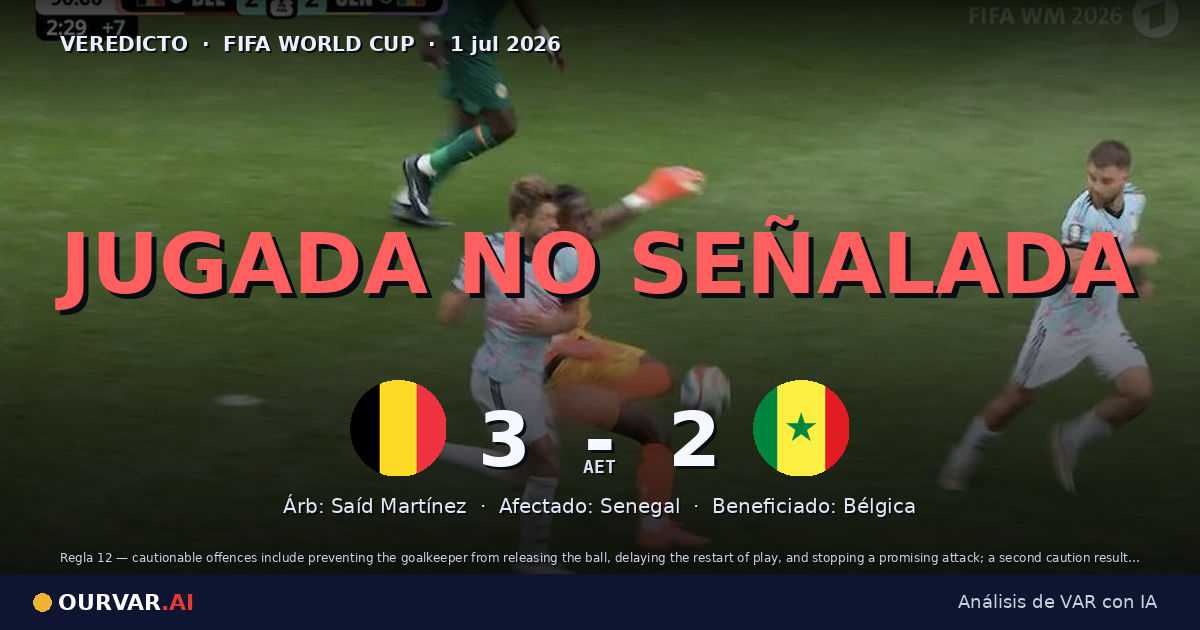
OURVAR ha juzgado la decisión del árbitro: Incorrecto (sin pitar). Estás votando si el análisis de OURVAR es correcto, no sobre el árbitro.
¿Estás de acuerdo con el veredicto de OURVAR?
Cada voto ayuda a afinar la precisión de OURVAR — y te lo agradecemos. La AI no es infalible, y tu veredicto es exactamente lo que la mejora, caso por caso. Estás ayudando a construir el VAR que todos merecemos. 🙏
In the 97th minute of a 2-2 knockout tie, Belgium's Mechele — already on a yellow card — blocked the Senegal goalkeeper from releasing the ball to launch a quick counter-attack. The referee showed no card, and VAR did not intervene; Belgium won in extra time. The correct call on the field was a second yellow and a sending-off: preventing the keeper's release, delaying the restart, and stopping a promising attack are all cautionable offences, and a second caution is a red. So the referee made a clear on-field error, with real consequences — Belgium should have finished the tie and played extra time a man down. However, VAR's non-intervention was correct and unavoidable. The 2026 rules did expand VAR's remit to second yellow cards, but only in one direction: VAR may overturn a second yellow that was wrongly awarded, and is expressly not permitted to recommend or add a second yellow that the referee did not show. Because no card was given, there was nothing for VAR to overturn, and adding the missed booking is outside its power. This is therefore a refereeing error that VAR had no authority to fix — not a VAR failure. WRONG DECISION (on-field), medium-high confidence.
Lee el análisis completo de OURVAR
Regístrate para ver cada punto clave, las cláusulas IFAB citadas y el razonamiento cuadro a cuadro detrás del veredicto.
- Puntos clave que guiaron la decisión de la IA
- Citas completas de las Leyes IFAB + referencias de cuadros
- Vota, comenta y debate con otros aficionados
Pregunta a OURVAR
¿Una duda sobre este veredicto?
Cuestiona el veredicto. Pregunta a OURVAR "¿por qué?", "¿y el ángulo del codo?", "¿qué precedente hay?" — y recibe respuestas fundamentadas en las Leyes IFAB del mismo modelo que analizó el caso. Pro 25/mes · WC 50 · GB 150.


Discusión