
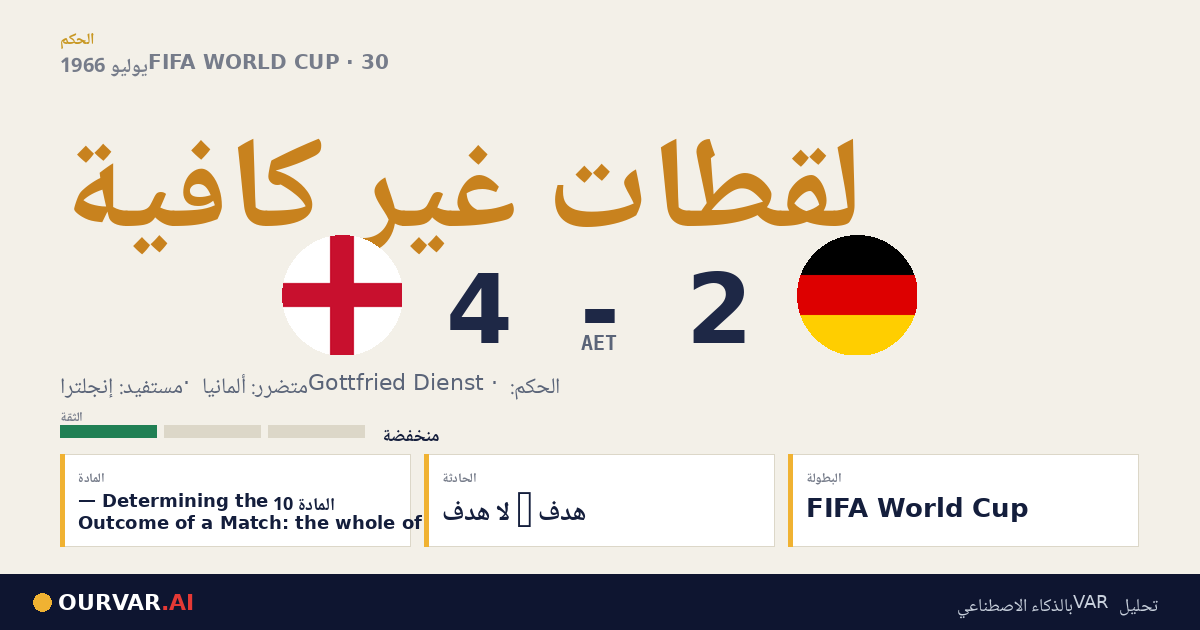
حكم OURVAR على قرار الحكم: لقطات غير كافية. أنت تصوّت على مدى صحة تحليل OURVAR — وليس على الحكم.
هل توافق على حكم OURVAR؟
كل تصويت يساعد على تحسين دقة OURVAR — ونحن ممتنون لذلك. الـ AI ليس معصومًا من الخطأ، وحكمك هو بالضبط ما يُطوّره، حالةً تلو الأخرى. أنت تساهم في بناء الـ VAR الذي نستحقه جميعًا. 🙏
This is the legendary "Wembley goal" from the 1966 FIFA World Cup Final, one of football's most contested decisions. Referee Gottfried Dienst — after consulting his Soviet linesman Tofiq Bahramov — allowed the goal for England, making the score 3-2 at the time. Under the Laws of the Game, the decision is simple in principle: the *whole* ball must cross the *whole* goal line. The problem is that these seven broadcast frames, taken from a high side-on camera angle with 1966-era resolution, simply cannot confirm or deny whether that happened at the critical instant. No frame captures the ball fully inside the net or fully outside; only the aftermath — Germany's #2 reacting near the post, players on the ground, the goalkeeper having dived — is visible. Based purely on what can be seen here, a verdict of **INSUFFICIENT FOOTAGE** is the only honest call. For context, a 2016 scientific reconstruction by Oxford University using photogrammetric analysis concluded the ball very likely did *not* fully cross the line — meaning Germany were probably the affected party — but that conclusion cannot be reached from these frames alone.
اقرأ تحليل OURVAR الكامل
سجّل لرؤية كل نقطة أساسية، وبنود قوانين IFAB المُستشهد بها، والتحليل لقطة بلقطة وراء هذا الحكم.
- النقاط الأساسية التي قادت قرار الذكاء الاصطناعي
- اقتباسات كاملة من قوانين IFAB + إشارات إلى اللقطات
- صوّت وعلّق وناقش مع جماهير آخرين
اسأل OURVAR
هل لديك سؤال حول هذا الحكم؟
تحدَّ القرار. اسأل OURVAR "لماذا؟"، "ماذا عن زاوية المرفق؟"، "ما السابقة؟" — واحصل على إجابات مستندة إلى قوانين الـIFAB من النموذج نفسه الذي حلّل الحالة. Pro 25/شهر · WC 50 · GB 150.


النقاش