
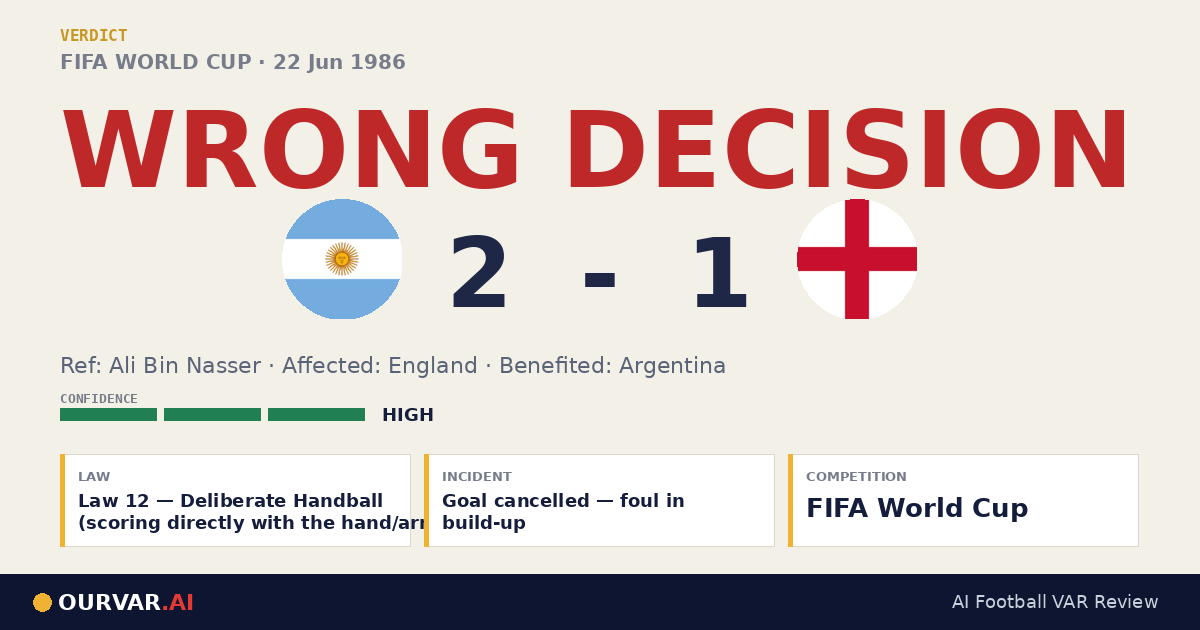
OURVAR judged the referee's decision: Wrong. You're voting on whether OURVAR's analysis is right — not on the referee.
Do you agree with OURVAR's verdict?
Every vote helps sharpen OURVAR's accuracy — and we're grateful for it. The AI isn't infallible, and your verdict is exactly what improves it, case by case. You're helping build the VAR we all deserve. 🙏
In this famous 1986 World Cup quarter-final, an Argentina attacker jumped and directed the ball into England's net with his hand/arm rather than his head. Under the Laws of the Game — which have always prohibited deliberate handball — this should have resulted in the goal being disallowed and a direct free kick awarded to England from inside the penalty area. The attacker should also have received a yellow card for unsporting behaviour. The referee and his assistants were not positioned to see the handball clearly and allowed the goal to stand, making this a clear **wrong decision**. There was no VAR in 1986, so the mistake was uncorrectable once play resumed, but the Law was unambiguously violated: you cannot deliberately punch the ball into the net and have the goal stand. England were the team who suffered from this missed call, and Argentina benefited from one of the most controversial refereeing errors in World Cup history.
Read the full OURVAR breakdown
Sign up to see every key factor, the IFAB law clauses cited, and the frame-by-frame reasoning that led to this verdict.
- Key factors that drove the AI's call
- Full IFAB law citations + frame references
- Vote, comment, and discuss with other fans
Ask OURVAR
Have a question about this verdict?
Push back on the verdict. Ask the AI 'why?', 'what about the elbow angle?', 'what's the precedent?' — and get IFAB-grounded answers from the same model that called the case. Pro 25/month · WC 50 · GB 150.


Discussion