
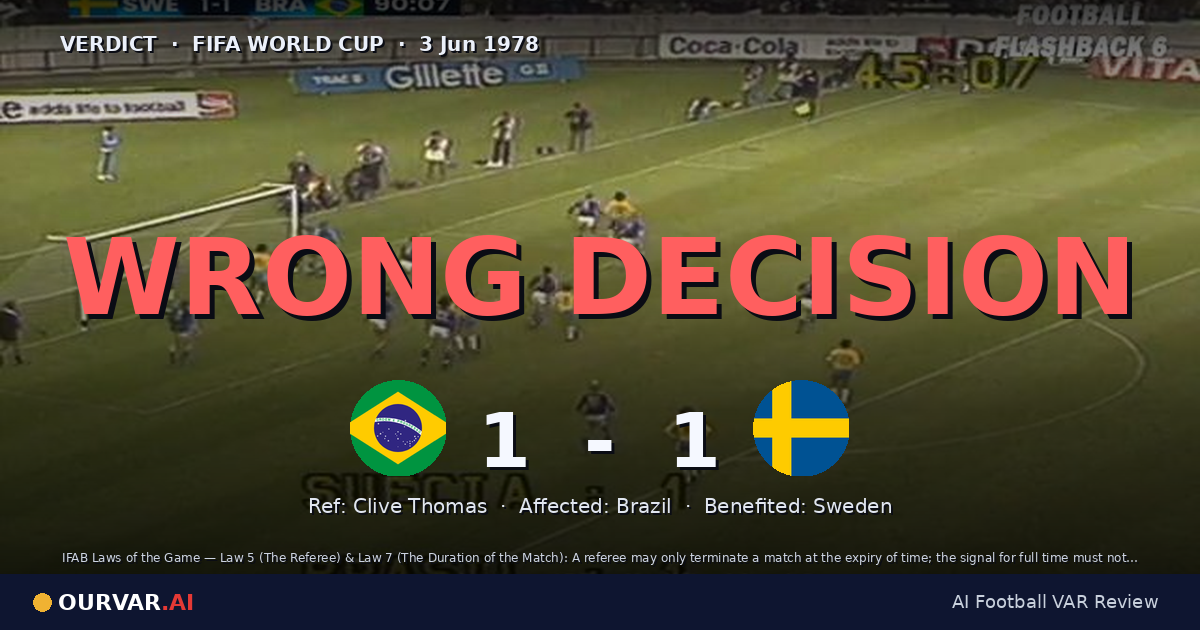
OURVAR judged the referee's decision: Wrong. You're voting on whether OURVAR's analysis is right — not on the referee.
Do you agree with OURVAR's verdict?
Every vote helps sharpen OURVAR's accuracy — and we're grateful for it. The AI isn't infallible, and your verdict is exactly what improves it, case by case. You're helping build the VAR we all deserve. 🙏
This is one of football's most controversial refereeing moments. At the 1978 World Cup, with the score at 1-1 and Brazil taking a corner in the final seconds, referee Clive Thomas blew his whistle for full time while the ball was still in the air — and Brazil's header went into the net moments later. Under the IFAB Laws of the Game (Law 7, Duration of the Match), a referee cannot end a match while the ball is actively in play. The corner was live, the ball was airborne, no infringement had occurred, and play had not naturally stopped. Thomas's decision to blow for time mid-flight was simply wrong: the goal should have counted, meaning Brazil — the affected team — were denied a 2-1 winning goal. Sweden benefited from the decision and the match finished 1-1. This decision is widely recognised, including by football authorities, as an incorrect application of the Laws, and it remains one of the most debated refereeing errors in World Cup history.
Read the full OURVAR breakdown
Sign up to see every key factor, the IFAB law clauses cited, and the frame-by-frame reasoning that led to this verdict.
- Key factors that drove the AI's call
- Full IFAB law citations + frame references
- Vote, comment, and discuss with other fans
Ask OURVAR
Have a question about this verdict?
Push back on the verdict. Ask the AI 'why?', 'what about the elbow angle?', 'what's the precedent?' — and get IFAB-grounded answers from the same model that called the case. Pro 25/month · WC 50 · GB 150.


Discussion