
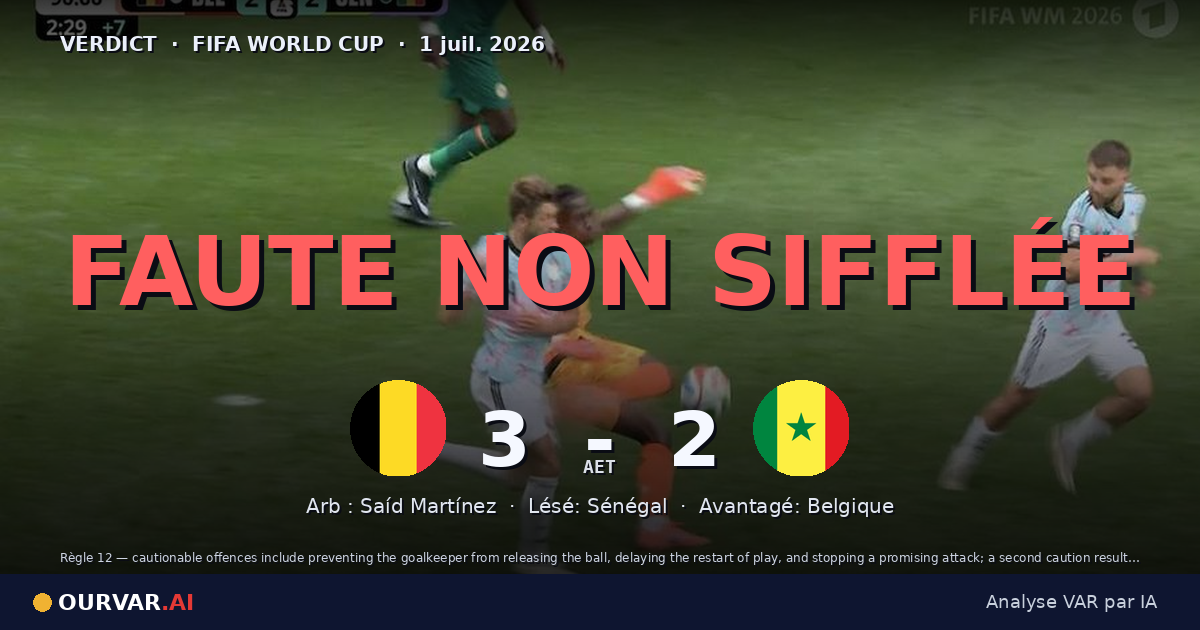
OURVAR a jugé la décision de l'arbitre : Incorrect (non sifflé). Vous votez pour savoir si l'analyse d'OURVAR est correcte — pas sur l'arbitre.
Êtes-vous d'accord avec le verdict d'OURVAR ?
Chaque vote contribue à affiner la précision d'OURVAR — et nous vous en sommes reconnaissants. L'AI n'est pas infaillible, et votre verdict est exactement ce qui l'améliore, cas après cas. Vous aidez à construire le VAR que nous méritons tous. 🙏
En 97e minute d'un match éliminatoire 2-2, le joueur belge Mechele, déjà averti d'un carton jaune, a entravé/bloqué le gardien de but du Sénégal dans la remise en jeu du ballon pour lancer un contre-attaque rapide. Aucun carton n'a été montré. La VAR n'a pas intervenu. La Belgique a remporté la victoire en prolongation.
Lis l'analyse complète d'OURVAR
Inscris-toi pour voir chaque point clé, les clauses des Lois IFAB citées et le raisonnement image par image derrière ce verdict.
- Points clés qui ont guidé la décision de l'IA
- Citations complètes des Lois IFAB + références d'images
- Vote, commente et discute avec d'autres fans
Demande à OURVAR
Une question sur ce verdict ?
Conteste le verdict. Pose à OURVAR « pourquoi ? », « et l'angle du coude ? », « quel précédent ? » — et reçois des réponses ancrées dans les Lois de l'IFAB par le même modèle qui a analysé le cas. Pro 25/mois · WC 50 · GB 150.


Discussion