
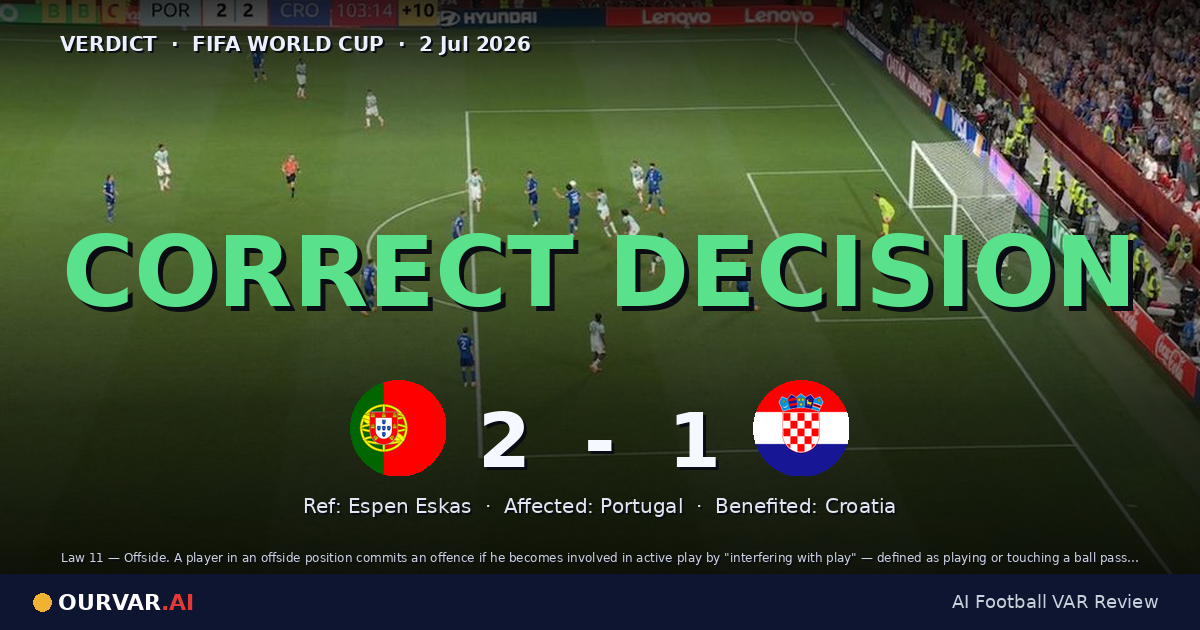
OURVAR judged the referee's decision: Correct. You're voting on whether OURVAR's analysis is right — not on the referee.
Do you agree with OURVAR's verdict?
Every vote helps sharpen OURVAR's accuracy — and we're grateful for it. The AI isn't infallible, and your verdict is exactly what improves it, case by case. You're helping build the VAR we all deserve. 🙏
Deep in extra time at 2-2, Croatia scored what looked like a dramatic equaliser against Portugal. The referee gave the goal, but VAR disallowed it for offside after checking connected-ball sensor data — and the reason is a subtle but exact application of Law 11. The player who delivered the final cross (#15) was onside. However, a different Croatian player, in an offside position, brushed the ball as it passed him — a contact on his hair or the top of his head, invisible to the naked eye but registered by the sensor inside the match ball. Under Law 11, a player in an offside position who touches a ball played by a teammate is "interfering with play," and that is an offside offence. Crucially, any touch qualifies: it does not need to change the ball's direction, and it does not need to be deliberate. So the offence was complete the moment the offside player made contact, regardless of what happened afterwards or of #15 being onside. This is a factual, objective determination — like goal-line technology — not a subjective judgement: the sensor either detected a touch or it didn't, and it did. CORRECT DECISION, high confidence. Brutal for Croatia, erased by a touch no human could have seen, but exactly right.
Read the full OURVAR breakdown
Sign up to see every key factor, the IFAB law clauses cited, and the frame-by-frame reasoning that led to this verdict.
- Key factors that drove the AI's call
- Full IFAB law citations + frame references
- Vote, comment, and discuss with other fans
Ask OURVAR
Have a question about this verdict?
Push back on the verdict. Ask the AI 'why?', 'what about the elbow angle?', 'what's the precedent?' — and get IFAB-grounded answers from the same model that called the case. Pro 25/month · WC 50 · GB 150.


Discussion