
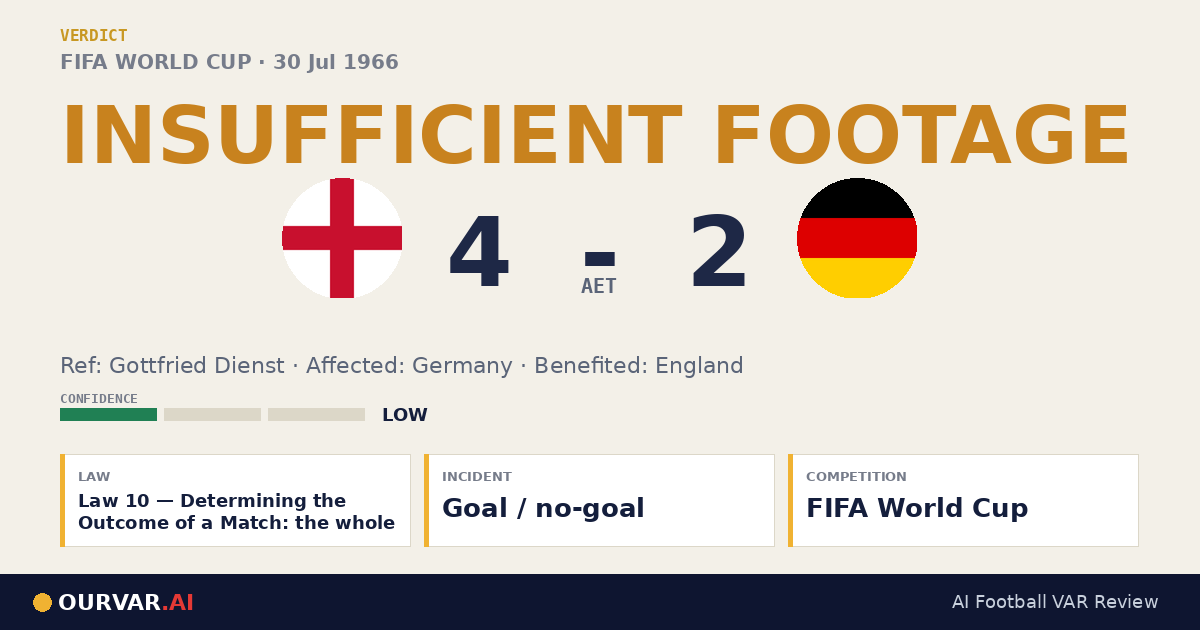
OURVAR judged the referee's decision: Insufficient Footage. You're voting on whether OURVAR's analysis is right — not on the referee.
Do you agree with OURVAR's verdict?
Every vote helps sharpen OURVAR's accuracy — and we're grateful for it. The AI isn't infallible, and your verdict is exactly what improves it, case by case. You're helping build the VAR we all deserve. 🙏
This is the legendary "Wembley goal" from the 1966 FIFA World Cup Final, one of football's most contested decisions. Referee Gottfried Dienst — after consulting his Soviet linesman Tofiq Bahramov — allowed the goal for England, making the score 3-2 at the time. Under the Laws of the Game, the decision is simple in principle: the *whole* ball must cross the *whole* goal line. The problem is that these seven broadcast frames, taken from a high side-on camera angle with 1966-era resolution, simply cannot confirm or deny whether that happened at the critical instant. No frame captures the ball fully inside the net or fully outside; only the aftermath — Germany's #2 reacting near the post, players on the ground, the goalkeeper having dived — is visible. Based purely on what can be seen here, a verdict of **INSUFFICIENT FOOTAGE** is the only honest call. For context, a 2016 scientific reconstruction by Oxford University using photogrammetric analysis concluded the ball very likely did *not* fully cross the line — meaning Germany were probably the affected party — but that conclusion cannot be reached from these frames alone.
Read the full OURVAR breakdown
Sign up to see every key factor, the IFAB law clauses cited, and the frame-by-frame reasoning that led to this verdict.
- Key factors that drove the AI's call
- Full IFAB law citations + frame references
- Vote, comment, and discuss with other fans
Ask OURVAR
Have a question about this verdict?
Push back on the verdict. Ask the AI 'why?', 'what about the elbow angle?', 'what's the precedent?' — and get IFAB-grounded answers from the same model that called the case. Pro 25/month · WC 50 · GB 150.


Discussion