
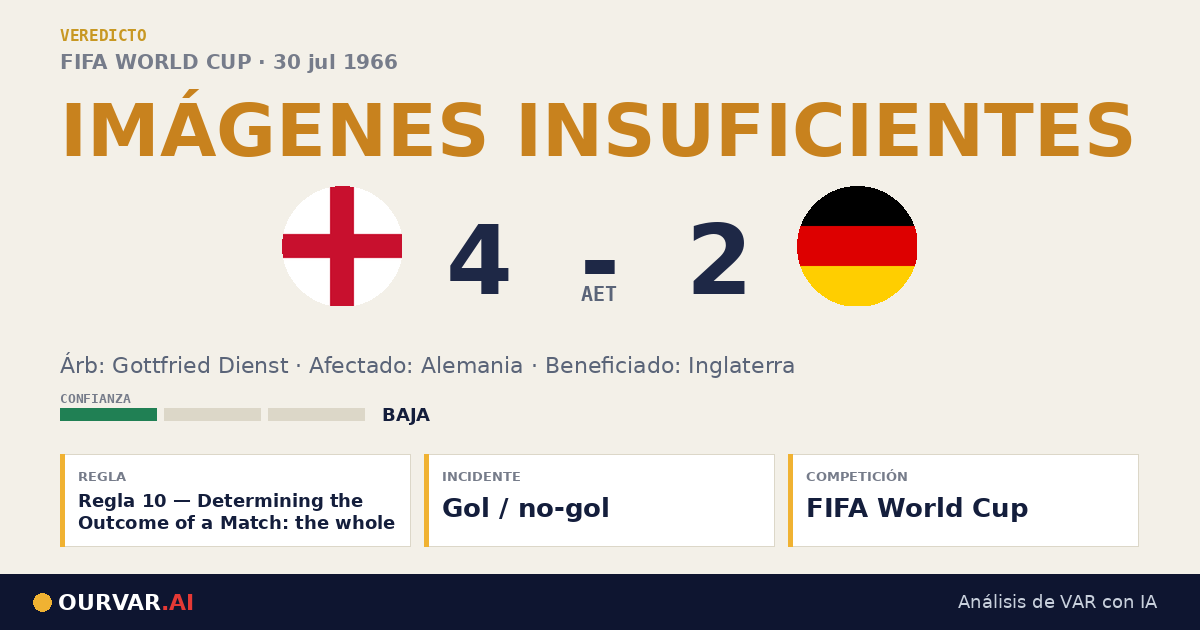
OURVAR ha juzgado la decisión del árbitro: Imágenes insuficientes. Estás votando si el análisis de OURVAR es correcto, no sobre el árbitro.
¿Estás de acuerdo con el veredicto de OURVAR?
Cada voto ayuda a afinar la precisión de OURVAR — y te lo agradecemos. La AI no es infalible, y tu veredicto es exactamente lo que la mejora, caso por caso. Estás ayudando a construir el VAR que todos merecemos. 🙏
This is the legendary "Wembley goal" from the 1966 FIFA World Cup Final, one of football's most contested decisions. Referee Gottfried Dienst — after consulting his Soviet linesman Tofiq Bahramov — allowed the goal for England, making the score 3-2 at the time. Under the Laws of the Game, the decision is simple in principle: the *whole* ball must cross the *whole* goal line. The problem is that these seven broadcast frames, taken from a high side-on camera angle with 1966-era resolution, simply cannot confirm or deny whether that happened at the critical instant. No frame captures the ball fully inside the net or fully outside; only the aftermath — Germany's #2 reacting near the post, players on the ground, the goalkeeper having dived — is visible. Based purely on what can be seen here, a verdict of **INSUFFICIENT FOOTAGE** is the only honest call. For context, a 2016 scientific reconstruction by Oxford University using photogrammetric analysis concluded the ball very likely did *not* fully cross the line — meaning Germany were probably the affected party — but that conclusion cannot be reached from these frames alone.
Lee el análisis completo de OURVAR
Regístrate para ver cada punto clave, las cláusulas IFAB citadas y el razonamiento cuadro a cuadro detrás del veredicto.
- Puntos clave que guiaron la decisión de la IA
- Citas completas de las Leyes IFAB + referencias de cuadros
- Vota, comenta y debate con otros aficionados
Pregunta a OURVAR
¿Una duda sobre este veredicto?
Cuestiona el veredicto. Pregunta a OURVAR "¿por qué?", "¿y el ángulo del codo?", "¿qué precedente hay?" — y recibe respuestas fundamentadas en las Leyes IFAB del mismo modelo que analizó el caso. Pro 25/mes · WC 50 · GB 150.


Discusión