
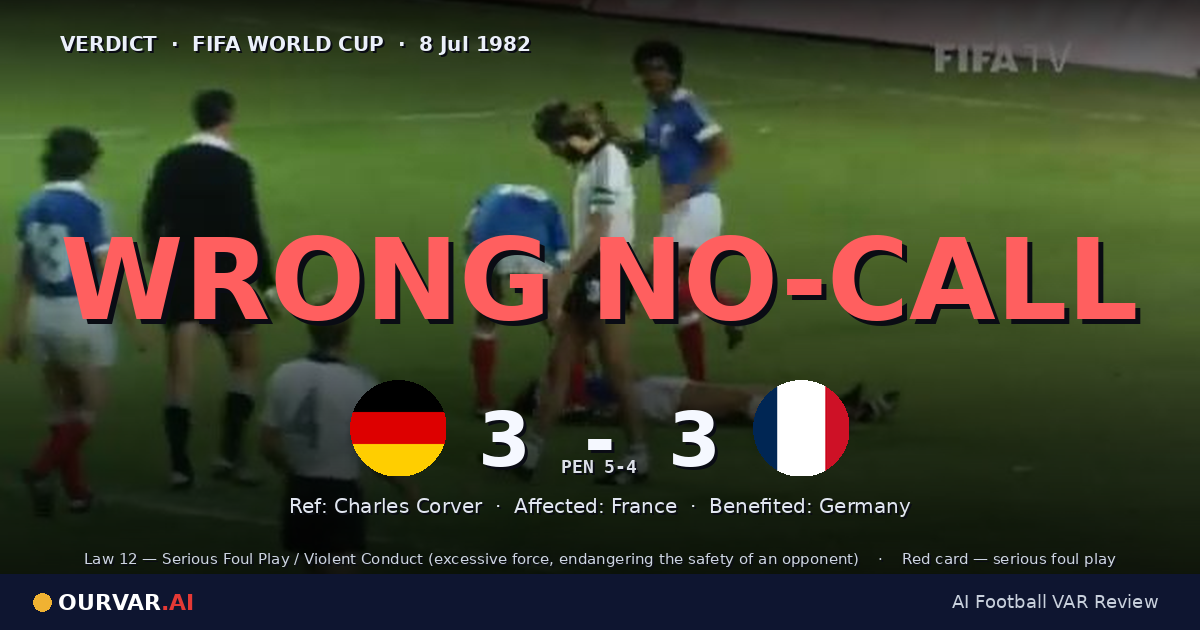
OURVAR judged the referee's decision: Wrong (No Call). You're voting on whether OURVAR's analysis is right — not on the referee.
Do you agree with OURVAR's verdict?
Every vote helps sharpen OURVAR's accuracy — and we're grateful for it. The AI isn't infallible, and your verdict is exactly what improves it, case by case. You're helping build the VAR we all deserve. 🙏
In this infamous 1982 World Cup semi-final moment, France's Battiston ran onto a through-ball and was struck by Germany's goalkeeper Schumacher with no attempt to play the ball — the frames show the collision at pace with no ball at the point of contact, and the immediate aftermath shows Battiston lying completely motionless on the pitch while his team-mates gathered around in visible alarm. Under IFAB Law 12, any challenge using excessive force that endangers an opponent's safety is serious foul play — it demands a red card and a free kick (or potentially a penalty, depending on exact location) regardless of era or competition. Referee Charles Corver gave nothing — no foul, no free kick, no card — and play continued. Germany went on to win on penalties with Schumacher playing a key role. This is one of the most egregious missed calls in World Cup history: by every applicable IFAB standard, Schumacher should have been sent off and France awarded a free kick at the very minimum.
Read the full OURVAR breakdown
Sign up to see every key factor, the IFAB law clauses cited, and the frame-by-frame reasoning that led to this verdict.
- Key factors that drove the AI's call
- Full IFAB law citations + frame references
- Vote, comment, and discuss with other fans
Ask OURVAR
Have a question about this verdict?
Push back on the verdict. Ask the AI 'why?', 'what about the elbow angle?', 'what's the precedent?' — and get IFAB-grounded answers from the same model that called the case. Pro 25/month · WC 50 · GB 150.


Discussion